Russian Spring. Photographer's Notes
The soothing clatter of the wheels — the Kyiv–Kharkiv train is picking up speed. The compartment is warm and cozy; tea is already being served. Thoughts swarm like bees, and it is hard to shake the anxiety: for me, this assignment is the first, a step into the unknown.
The events of the winter of 2014 and the early spring had been unfolding at a breathtaking pace. Yanukovych’s escape to Russia, the Russian invasion of Crimea, and the pseudo-referendum on March 16, after which Putin announced the “annexation” of the peninsula. At the same time, pro-Russian forces were increasingly destabilizing Donbas.
On March 13, during a rally for Ukraine’s unity in Donetsk’s central square, Ukrainian activist Dmytro Cherniavskyi was killed. And on April 6, pro-Russian forces seized the buildings of the Security Service in Luhansk and the Donetsk Oblast State Administration, where on April 7 they proclaimed the creation of the so-called Donetsk People’s Republic.
And now — alarming news from Kharkiv. On that same April 7, pro-Russian forces seized the Kharkiv Oblast State Administration. Since the beginning of spring, the city had been feverish: as early as March 1, pro-Russian activists had stormed the administration, beaten Euromaidan supporters, and forced them to their knees. Now they have taken down the Ukrainian flag over the building and are preparing to proclaim yet another “people’s republic.”
It is toward this city of Kharkiv that the train rushes that April evening. I still have no idea what I am about to go through or what events I will witness. Each new day brings new challenges, and it becomes harder and 2 harder to believe that all of this is happening in your own country, as the events of each day overshadow everything that came before. Not every episode of that spring becomes a photograph. But the most vivid ones remain in memory forever.
Kharkiv railway station greets me with empty platforms. Perhaps it was a mistake to have first taken my luggage to the hotel near Freedom Square. As I approach the Oblast State Administration building, I realize I am late. Just half an hour earlier, everything here had already ended. The square is patrolled by police, and near the building stand men in masks and black uniforms. Machine guns, assault rifles, stern, heavy looks.
Later I learn that it was the “Jaguar” special unit of the Ministry of Internal Affairs from Vinnytsia that retook the building without a single shot. All the attackers have already been arrested and are being held in the inner courtyard. I only manage to notice a frail, frightened, very young man in camouflage pants, whom the police lead into the administration building.
Piles of trash, tires, and broken furniture in front of the entrance are already being cleared by communal workers. A few passersby, hurrying about their business, glance with surprise at the special forces. Near the police cordon, people with St. George ribbons* begin to gather. Without much enthusiasm, they provoke the officers, who do not react.
Surprisingly, I pass through the cordon without any obstacles. In the soot-covered lobby, I am greeted by a bust of Taras Shevchenko. What catches the eye is a sheet of foam board with the word “Russia” written in large black letters, hidden behind it. I go up to the second floor. Fire hoses are still lying around, bottles with dark liquid stand in the corners, and staff are sluggishly clearing the disorder left after the seizure. In the open assembly hall, tables are piled with loaves of bread, cookies, cheap instant noodles, and tea. Everywhere — large bottles of water. Those who seized the administration were clearly preparing to stay here for a long time.
The calm is broken by noise from the street. From the window, Freedom Square — the largest in Europe — is clearly visible. At its beginning stands the Lenin monument. Several officers silently watch as organizers try to ignite a small crowd held back by a police cordon. Among the people with “Colorado” ribbons* and Russian flags, small active groups form; they rush at the police, but there is a lack of energy and force. Some, noticing me with a camera at the window, grimace and show middle fingers.
In one place, the crowd attempts to break through, but after encountering batons, it retreats. Women’s cries and curses can be heard. The most active participants are pulled out of the crowd by police and taken aside. Meanwhile, behind them, right in the middle of the square, a pro-Ukrainian rally begins to form — the police set up another cordon.
Closer to noon, a group led by young men carrying a red banner with a star and the words “No elections without a referendum!” approaches the square. The name of the political force holding its “peaceful” rally leaves no doubt. Activists of the left-wing group “Borotba” had already been seen at anti-Maidan actions in various Ukrainian cities. The group disappeared as unexpectedly as it had appeared on the country’s political map, shortly after the presidential elections at the end of May 2014.
For now, the young men try to stir up the small group of people with “Colorado” ribbons still remaining in front of the administration building, and after a while the disorganized crowd moves toward the side entrance to the courtyard. After a brief exchange with the police through the closed gates, calls are heard to head to the court, where preventive measures for the participants of the storming are being decided — and the crowd begins to thin out.
By evening, tensions gradually subside. Kharkiv returns to its everyday life. Only within the walls of the administration building does work continue at full pace: employees and communal workers carefully wash soot from the floors and walls. *The St. George’s ribbon, a black-and-orange striped symbol widely used in Russian military propaganda and adopted by pro-Russian forces during the conflict in eastern Ukraine, after which it came to be derisively referred to as the “Colorado” ribbon, after the Colorado potato beetle.


A gloomy April morning. Freedom Square is empty. I have always admired Kharkiv — its openness, its parks, and the incredible sense of airiness in the city center. A few passersby linger near the State Administration building, where the shattered windows have already been boarded up with plywood. The Ukrainian flag flies above it. Yet the calm feels deceptive. At the edge of the square stand rows of aluminum shields with rubber batons and metal helmets attached. Nearby, groups of police officers wait, as if anticipating something. Yesterday’s stern special forces are nowhere to be seen. People head to work, someone takes a child to kindergarten, a girl carries flowers — and it almost feels as if the unrest of the past few days never happened.
I approach the administration building. There is not even a police cordon here. After a while, a unit of riot police in full gear crosses the street and heads toward the building. I try to get a shot from a higher angle, raising my camera — and receive a sharp удар with a shield to the chest from one of the officers… The formation of law enforcement disappears into the courtyard of the administration. A clear realization sets in: the “Kharkiv People’s Republic” died before it was even born.
After a brief discussion with the Agence France-Presse (AFP) photo service chief Serhiy Supinskyi, we decide that I need to go to Donetsk. That is where events are unfolding at a staggering pace. That is where, on April 7, a new “republic” has already emerged — one whose main goal will be the destruction of Ukraine.


In the evening, cozy and tidy Donetsk greets me with lights. A small hotel on 50th Anniversary of the USSR Street, where many colleagues are staying, offers me a place. The seized Oblast State Administration building is just three blocks away along Shevchenko Boulevard. Images from the news flash through my mind: a crowd storming police lines, protesters breaking through the cordon, entering the building for the third time. I cover the distance in a single breath.
A monumental statue of the poet stands ahead. Behind it, the brightly lit administration building. Another hundred meters — and I come across an improvised “border post” topped with a double-headed eagle. Beside it stands a young man holding a Russian flag. His youthful, handsome face and the seriousness with which he holds the fabric give the scene a strange solemnity. A tricolor also flies on the flagpole near the building. Behind him — a small crowd, mostly young men. A truck has just delivered tires, which are being unloaded in front of the building. Calls can be heard urging people to come in the morning and build barricades.
The encounter with a new reality has taken place. Tomorrow, there will be much work to do. I return to the hotel, trying not to think about it.

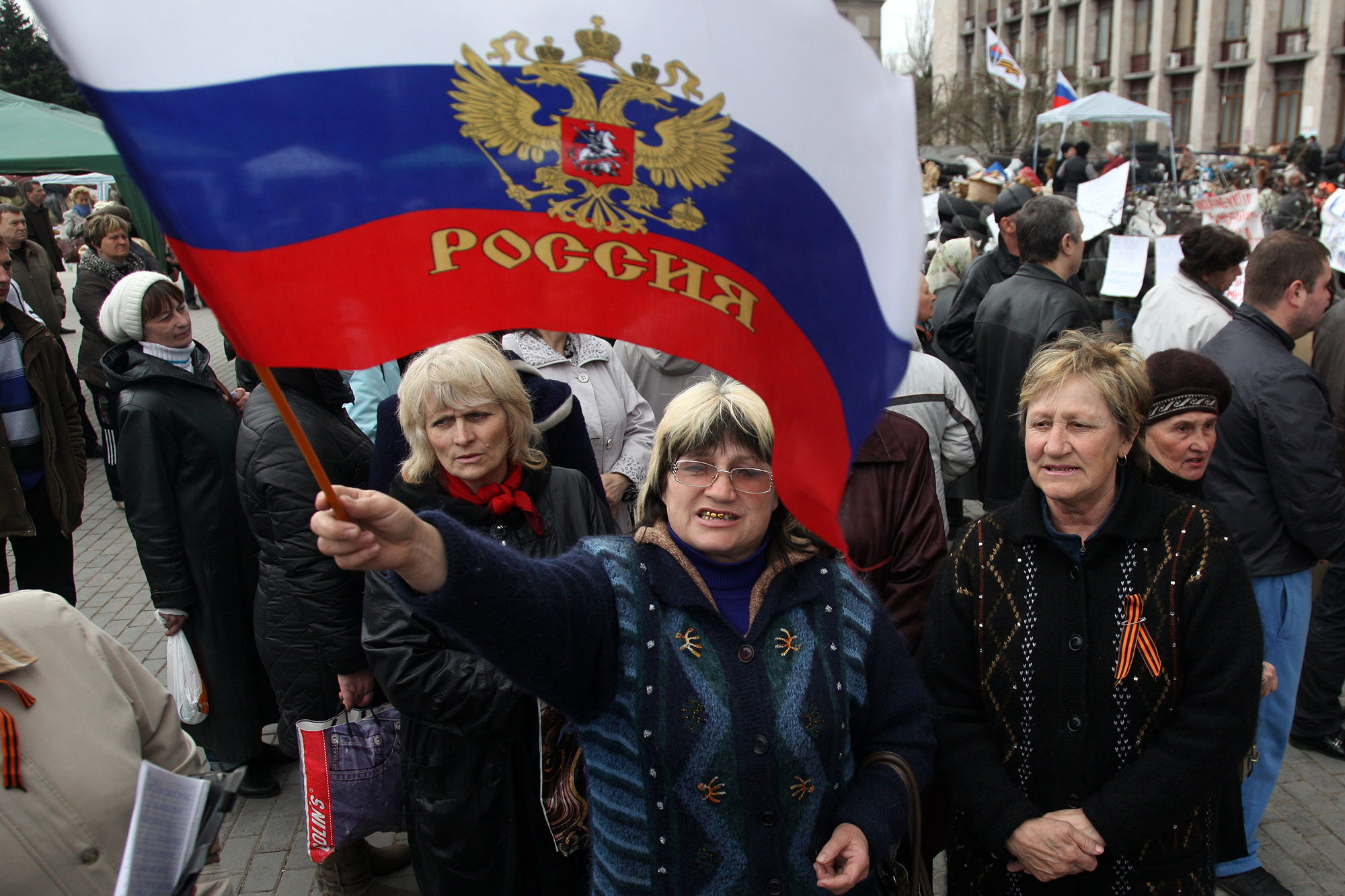
A gloomy sky hangs over the Donetsk Oblast State Administration, the way to which is blocked by a barricade of tires topped with stretched barbed wire. There are still few people, but the first ones I encounter are a group of women in their fifties, waving a Russian flag and chanting slogans. Nearby stands a young man in chainmail, an iron helmet, and holding an axe. Several St. George ribbons are attached to the “knight’s” armor. A few more guards in construction helmets can be seen on the barricades.
A feeling arises that everything happening here is meant to copy Kyiv’s Maidan. From time to time, announcements over a loudspeaker say that the leadership of the “young republic” is making important decisions today, and people are urged to bring as many friends and acquaintances as possible. Gradually, the square in front of the administration fills with people.
The crowd begins to get openly bored. But then a representative of the new “authorities” comes out of the building and announces: a decision has been made to hold a referendum on the status of the “Donetsk People’s Republic.” The statement energizes the atmosphere. The square comes alive. The most enthusiastic form a column and head into the city carrying a banner taken from the administration. It reads: “We are peaceful people. We are for a referendum.” The fact that the message is duplicated in English makes it clear: the appeal is addressed to the world. However, the word “peaceful” keeps an ominous undertone…

Men start building barricades. Tires are everywhere, along with sandbags used to block approaches to the administration. I see an elderly man rolling a huge truck tire, while nearby women with shopping bags drag a sack of sand along the ground. Clearly, the announcement of the referendum has given a new impulse, has inspired those present. The barricade quickly expands into a second perimeter.
Here is a woman with a kindly face and a large plastic jar, standing right by the barricade, collecting donations in support of the “young republic.” People push banknotes inside, and the jar quickly fills up. I step closer to take a photo.
“Who are you?” — I turn around, whether at the question or the shove in my back. My answer, “A journalist. Shooting for a French agency,” only makes the blonde woman in her fifties even harsher. She steps back, exhales the smell of alcohol, and, pressing her finger into my chest, declares bluntly: “This is an enemy of the people!” A tight circle of similar women and older men with stone faces closes around me.
Now this situation might seem rather comical, but at the time it was anything but funny. The ominous pause drags on. I spread my hands and, offering the lady a smile, say something like—I don’t quite look like an enemy of the people… The situation is defused by a man in a mask and an iron helmet, who demands to see my documents. After that, I quickly move to another part of the square.
Here, elderly women with identical signs in English declare that they are afraid of fascism. Soviet flags wave, and some participants call on Merkel and Obama to keep their hands off Ukraine.
The tension of the rally subsides. Some people warm themselves by metal barrels with fires burning inside, others head home.


Another gloomy morning brings terrible news. Around six in the morning, an explosion occurred in a coal seam at the Skotchynskyi mine — one of the deepest in the world. The rallies near the Oblast State Administration suddenly feel secondary.
I turn to a local photographer, Sasha Khudoteplyi, for advice. He calmly recommends not going — miners don’t like journalists, and in moments like this they might even turn aggressive. Still, having no such experience, we decide to go.

On the large square in front of the mine administration building, rescue service buses are parked. The entrance to the shaft swallows the new shift, but while rescue operations continue below, miners remain waiting on the surface.
Nearby, anxious women gather at the entrance to the administration building. They argue loudly and demand to be let inside.
The miners stand in small groups near the police under a canopy. It is strikingly quiet. Frozen faces, distant gazes. Some look at photographers with surprise as we raise our cameras.
Somewhere deep underground — at a depth difficult even to imagine — their fellow miners have died. But they will still have to go down there.
After some time, rescuers emerge. Tired, faces covered in coal dust, sadness in their eyes. They carry stretchers and equipment, passing by as if not noticing us.
Then the bodies are brought out. Miners, lamps on their helmets, carry them in bags. They are loaded into a van. From the direction of the administration building, a piercing scream is heard.
I am filming something like this for the first time. I feel uneasy at how closely and unceremoniously I have touched this tragedy. That morning, seven miners died in the mine. The youngest was twenty-two.
No one touches us.


Back in Donetsk, near the Oblast State Administration, emotions are running high. There are even more people today. Armed guards in masks stand at the entrance. Soviet symbols are everywhere. Russian flags flutter, now tied with mourning ribbons. Speeches are made, slogans shouted — it becomes increasingly clear that the organizers are trying to raise the temperature.
Oleh Tsarov takes the stage. “Referendum,” “young republic,” “no to fascism” — familiar slogans. The crowd responds, chanting, raising fists.
After what I saw in the morning, there is a strange dissonance. The rally feels repetitive, looping. Tension hangs in the air, as if waiting for something more. The next day will show that this feeling is not accidental.


You had to feel that springtime Donetsk. A cozy, well-kept city. A measured, peaceful life. Only near the Oblast State Administration building were there barricades and the daily bustle of rallies, which occasionally spilled into the city but seemed to be gradually fading with each passing day.
The news that morning brought word that unknown armed men had seized the police department in Sloviansk. What had been happening in Donbas that spring up to this point could still be called a “peaceful” protest. But the words “armed men” opened a new chapter in this story.
Everything I knew about Sloviansk before that day was that a train stopped there on the way from Kyiv to Donetsk. And also its resounding name, which now gave the situation a strange symbolism. All the journalists who happened to be in Donetsk at the time rushed there, competing with one another. Leaving our belongings at the hotel, we sped toward Sloviansk by car. We pass Kramatorsk and stop on the highway opposite Mount Karachun. A majestic view opens before us: a town spread out across a wide valley, with a hill crowned by a TV tower rising above it, and a white chalk ridge visible further away.
We put on body armor under our jackets. A few more minutes — and we are in the town. It didn’t take long to find the police station: it is in the center. Already on the approach — a huge crowd. It feels like half the town has gathered here. The station itself is located in a narrow passage between buildings, and the street is blocked on both sides by barricades of tires and police shields. I catch myself thinking: a very advantageous place for defense.
Something invisible pulls me closer — to the barricade, to the epicenter of the event. I squeeze through a narrow gap between the shields and the wall of a building and find myself inside the perimeter. Behind me, the crowd presses forward; ahead of me stands a man in an iron helmet with an assault rifle. For a moment, it becomes truly frightening. He lets me pass without unnecessary questions after seeing the camera and hearing that I’m shooting for an international agency. It’s good he doesn’t ask for credentials — which I don’t have.
Inside, there are many armed men — not in military uniforms. The Ukrainian trident above the entrance to the police station is covered with a rag, and a Russian flag hangs nearby. The uneasy discomfort doesn’t go away. I feel dozens of suspicious glances on me. Armed men move in and out of the building — a nervous, constant motion. Some whisper with locals, others shout slogans. Women behind the shields are passing packages of food. The sense of danger becomes almost physical.
A man with a rifle approaches one of my colleagues and asks for documents. I realize it’s time to leave — I don’t need unnecessary questions.
I stay there for ten to fifteen minutes. I do what I can. I leave the same way back into the town, where activity is already in full swing.


At the entrance to Sloviansk from the Cherevkivka side, checkpoints are being built on the bridges. Armed men are checking vehicles. Their bearing and equipment make it clear: these are not random activists. Local youth carry sandbags. Russian flags fly over the fortifications. Everywhere there is a strange, feverish sense of excitement.
It is incredibly surreal. Unnatural. But at that time, there was still no word that could fully explain it. There was only a firm understanding: something new is happening. Nothing like this had yet occurred in Donbas that spring.
The “Ukraina” Hotel on Shevchenko Boulevard had probably not seen such a full occupancy in a long time — by evening, almost all rooms were booked by journalists.
We go back to Donetsk just to collect our luggage. It is already clear: the history is in the making in Sloviansk. A woman with a tired face at the reception desk of the Donetsk hotel asks, “When will all this end?” I couldn’t answer her. How many times over the past twelve years have I heard this question from residents of Donbas? I still don’t know the answer.
We return to Sloviansk via Dobropillia. On the approach to Kramatorsk, the radio reports: the town police department there has also been seized by armed men. Ahead, the night town lighting — the town whose life has already been divided into “before” and “after.”


The sound of a helicopter engine seeps through the closed windows. From afar, you can hear the blades beating the air. It grows louder, then slowly fades away. Time to get up. The “Ukraina” hotel is waking up. Thoughts swarm in my head. It’s already known that the police stations in Sloviansk and Kramatorsk have been seized by a group led by a Russian officer named Girkin. He has declared himself the commander of the “militia” and is demanding obedience from local law enforcement. Alright, enough playing around. Today it has to stop. This trash can’t possibly go on like this.
We get ready quickly and head to the police station. The Russian flag is no longer there, but overnight the barricades have grown significantly. Sandbags, tires, clay. On top of it all now—barbed wire and a black-blue-red banner reading “Donetsk Republic.” From behind the backs of the men standing on the barricade, a man in camouflage watches us closely.
Again, the sound of a helicopter echoes in the distance. Now it’s clearly visible. High in the sky, an attack helicopter Mi-24 sweeps past. Everything around starts to move. From the barricade come calls to bring more women and children. The women nearby eagerly grab hands and form a human chain in front of the barricade. Local men stand behind them.
Without proper press credentials, I see no reason to stay longer. The decision to walk around the town comes naturally. The morning rain has stopped, and the cozy town center is filled with fresh April air.
At the end of the street, I notice them. Two men. With assault rifles. They walk with quick, predatory steps. Camouflage, masks covering their faces, St. George ribbons. The one in front is right-handed, the one behind is left-handed—so they can quickly open fire in both directions if needed. It becomes immediately clear: these are professional soldiers. They are already patrolling the streets. The calm mood evaporates. I take just a few shots and try to disappear from their sight.


I don’t know Sloviansk at all, so the taxi driver waiting at the intersection is a welcome help. I get into his Lanos and ask him to drive me around, to show the entrances to the town. Like a large ink blot, it spreads across a wide valley with varying elevations, a river, and salt lakes.
First stop—Slavkurort. We pass the lakes, a few more turns—and run into a barricade made of burning tires. Thick black smoke covers everything. Young men keep throwing more tires into the fire. Police shields and «Colorado» ribbons are here too. I notice a man with a Makarov pistol tucked under his body armor. I take a few shots. The driver waits. We move on.
Another exit from the town—near a feed mill. A large grain elevator looms to the right. Straight ahead, at an intersection about 400 meters away, I see people. The sound of automatic gunfire reaches us faintly through the closed car windows. The driver abruptly stops the Lanos and makes a sharp U-turn, scraping both sides of the road. We speed away from that place.


We head toward the entrance from Cherevkivka. Blockposts had been set up there the night before. A wide avenue lined with white poplars ends, and to the left I already see a barricade at the bridge over the Kazennyi Torets River. “Move the car out of the line of fire!” — a sharp shout catches me off guard as I step out of the vehicle.
I turn around. I see the barrel of a rifle pointed at me and a man in camouflage and mask lying on the roadside slope in a firing position. A few of his comrades are conferring nearby. I don’t feel fear—just a cold chill down my spine.
I ask the driver to move past the intersection while I stay.
A strange mix of curiosity and real danger unsettles me. Why are these armed men here? What are they doing in my country? Running is not an option—that would be the end. I try to steady myself and begin to speak. They see that I’m a photographer and not a threat. The situation gradually stabilizes. I introduce myself, say I’m working for Agence France-Presse, and ask if I can take their photos.
A tall military man in a shaggy papakha engages with me. He calls someone, speaks briefly, then hangs up and says curtly: “Shoot.”
It starts to drizzle. An old man rides up on a bicycle and hands one of the fighters a blue raincoat. I take quick shots, but curiosity won’t let go. I start asking who they are, where they’re from, why they’re here.
His answers pull me into another reality: “We are Kuban Cossacks, Terek wolves. We came to save the Orthodox from the Greek Catholics. The National Guard will come across the bridge soon. We’ll crush them…”
I take a few more photos and return to the car. The militants are already focused on something else and no longer pay attention to me.
In August 2014, I accidentally came across information online that Ukrainian forces near Krasnodon had killed a well-known Russian special forces fighter who had participated in the events in Sloviansk. A familiar face looked back at me from the screen. That’s how I learned I had photographed militant Dmytro Ponomariov, call sign “Dingo.”


We slowly drive back to the town center. Again, the sound of helicopter engines overhead. My phone rings. A journalist asks if I can come to Semenivka—urgently. There was a clash there this morning.
A small café near the “Sloviansk” sign is crowded. A man is passionately convincing others that somewhere nearby Ukrainian soldiers fired on civilians returning from fishing. We clarify the location—further up the road toward Debaltseve.
There it is. A blue Volkswagen Transporter riddled with bullet holes stands on the road. Men bustle around it, peering inside, sorting through documents scattered on the seats. The letterhead leaves no doubt: it’s an SBU vehicle.
A little further, on an empty lot, a bullet-ridden Toyota jeep stands. It begins to rain, and small streams of water slowly wash away a pool of blood near the rear right door. The same men attach a cable and tow the vehicle away.
From what I see and hear, it’s hard to piece together a clear picture. But a fellow journalist next to me shows photos on his iPhone—he arrived right after the fight. In the image, a dead man in black uniform with an assault rifle is kneeling beside the jeep, his head bowed.
Much later, I learned what happened that April morning. A group of SBU “Alpha” officers and Donetsk police had been ambushed. Captain Hennadii Bielichenko was killed in that battle. In fact, he became the first casualty of the war that continues to this day.
Other officers were wounded, and their lives were saved by Vadym Sukharevskyi, a commander of the 80th Airmobile Brigade. His armored personnel carrier was nearby, and seeing the militants destroying the “Alpha” unit, he ordered his men to open fire with a machine gun. The attackers could not withstand the fight and retreated.
At that time, I didn’t know these details. Everything happening around creates a heavy, oppressive backdrop. The pendulum of events is swinging harder and harder. What seemed shocking or unreal yesterday no longer surprises today. The reporter’s thrill is still there, the desire to capture the moment. But alongside it, a growing awareness emerges of the scale of events unfolding right before my eyes.
Standing next to the bullet-riddled vehicles of the “Alpha” unit, I clearly realize: the armed men who came into my country are ready to kill.


Morning brings a realization: life has changed. We wake up in a different country. The anti-terrorist operation has begun. This morning, Acting President of Ukraine Oleksandr Turchynov signed the corresponding decree. The sense of irreversibility is becoming tangible.
Near the police station, blocked by barricades, it seems that life is settling into a steady rhythm. Firewood burns in metal barrels; women warm themselves nearby, hold Orthodox readings, drink coffee, pin “Colorado” ribbons to their lapels. There is no camouflage or assault rifles here anymore. Only a few young men with baseball bats stand on the barricade. Residents are called to gather for a meeting with the mayor outside the town council at three o’clock.


By the town council building itself, there is an interesting scene. I recognize some of the militants I photographed yesterday at the intersection near the bridge. They are guarding the entrance. The new authorities are now holding meetings here. People enjoy the sunny spring day: they stroll across the square, sit on benches. One young man enthusiastically paces around with a large Russian flag.


The taxi driver has been driving me for the third day in a row and is very pleased with our cooperation. We head toward the outskirts of the town, in the direction of Cherevkivka. On the bridges over the Kazennyi Torets River—piles of tires; a little further on, elderly women pray with icons. At the checkpoint before the bridges, some costumed “cossacks” diligently inspect cars.
Drivers obediently open their trunks and patiently wait until the checks are finished. Others stand in line.
I quickly grow tired of observing this “celebration” of the “young republic” and return to the town center.


People begin to gather in the square in front of the town council. Reporters sit on benches, enjoying the sun. Among them, I notice Russian photographers—RIA Novosti, Izvestia… Pigeons bathe in warm puddles. People chat while waiting for Mayor Nelya Shtepa.
I don’t remember anything from her speech—the words seemed to matter only to her. The rally lasted no more than twenty minutes. After that, the stirred-up crowd goes to fraternize with the Russian militants guarding the entrance to the town council. People hug them, take photos together, cheerfully chatter about how long they have been waiting for their “liberators.” Some even bring their children.
Gradually, emotions go down, and people leave.
The hum of aircraft engines grows in the sky—and instantly draws attention. Very low, right above the houses, the square, and the town council—over which a Russian flag is flying—a Ukrainian An-26 aircraft cuts across the sky.


Even on the fourth day after the seizure of Sloviansk, the situation still seems under control. The town lives its usual life — though quieter. A curfew is in place. At checkpoints, locals stand guard. Armed men, possibly Russians, are mostly seen at the entrance to the town council. Later, they move to the SBU building, setting up their headquarters there. At night and even during the day, bursts of automatic gunfire can sometimes be heard.
The previous evening, on Shevchenko Boulevard, not far from the hotel where we were staying, a Renault passenger car was riddled with bullets. A familiar scene: broken glass, scattered belongings, people searching through the remains, a crowd around it. Who had been inside it? What happened to those people? From the news, it became known that a passerby had been wounded — a bullet hit his jaw.
We all wait to see how the Ukrainian authorities will act after announcing the start of the anti-terrorist operation. And they seem determined. Information appears that Ukrainian forces are gathering near Izium for a further advance on Sloviansk.
The café “Slavny Gorod” had turned into a journalists’ hub. Every morning starts there: breakfast, searching for a taxi. When decisions are made collectively, it takes time. But what can you do? There are four of us. We head to Barvinkove. Somewhere on the border of the Oblasts, we’re supposed to meet and photograph Ukrainian troops. That’s the main story expected for today.
We pass the last checkpoint on the way out of the town — a small tricolor flag left behind us. The road winds through the valley. We drive for about forty minutes, mostly along the railway.
In the distance, houses begin to flicker into view, the road climbs a hill — and the driver suddenly brakes. Ahead is a fortified position. A police officer slowly approaches the car. Above the position, built from sandbags, a Ukrainian flag is flying.
Our documents don’t interest the police much — all attention is on the driver. His car and he himself are thoroughly checked. My attention, meanwhile, is completely absorbed by this post. The blue-and-yellow flag, Ukrainian police — perhaps the brightest thing I have seen in the past week. The national colors ripple in the wind. And for this very thing, back where we had just come from, people were ready to tear you apart.
We don’t encounter Ukrainian troops either in Barvinkove or its surroundings. We should have gone straight to Izium…
At the Izium checkpoint, it is almost over. As reported in the news, earlier that morning there had been intense activity there: press, military equipment, the roar of helicopters. We arrive too late for all of that. Only a bit further away, near a tree line, stand APCs in fresh paint, beside which Ukrainian soldiers in brand-new uniforms are talking among themselves. The evening sun sparkles against the backdrop of Ukrainian flags above the vehicles. Police officers in black briskly check transport at the checkpoint.
A bus Izium–Stakhanov drives out of the checkpoint. I catch the anxious glances of the passengers. Tense faces. We, too, head back to Sloviansk. The blue-and-yellow remains behind.


Perhaps this was the hardest day of that spring. A sunny morning brought another piece of news: in Kramatorsk, near the railway station, a column of Ukrainian paratroopers had been blocked, with the familiar pattern — women, children. That’s how the media reported it.
The same taxi driver takes me to Kramatorsk. We turn off Ordzhonikidze Street — it still had that name back then — toward the station. What opens before my eyes is hard to believe. In the distance, at the descent from the bridge, I see a column of military vehicles under Russian flags moving toward us. It is accompanied by civilian cars with local residents waving “colorado” ribbons out of open windows.
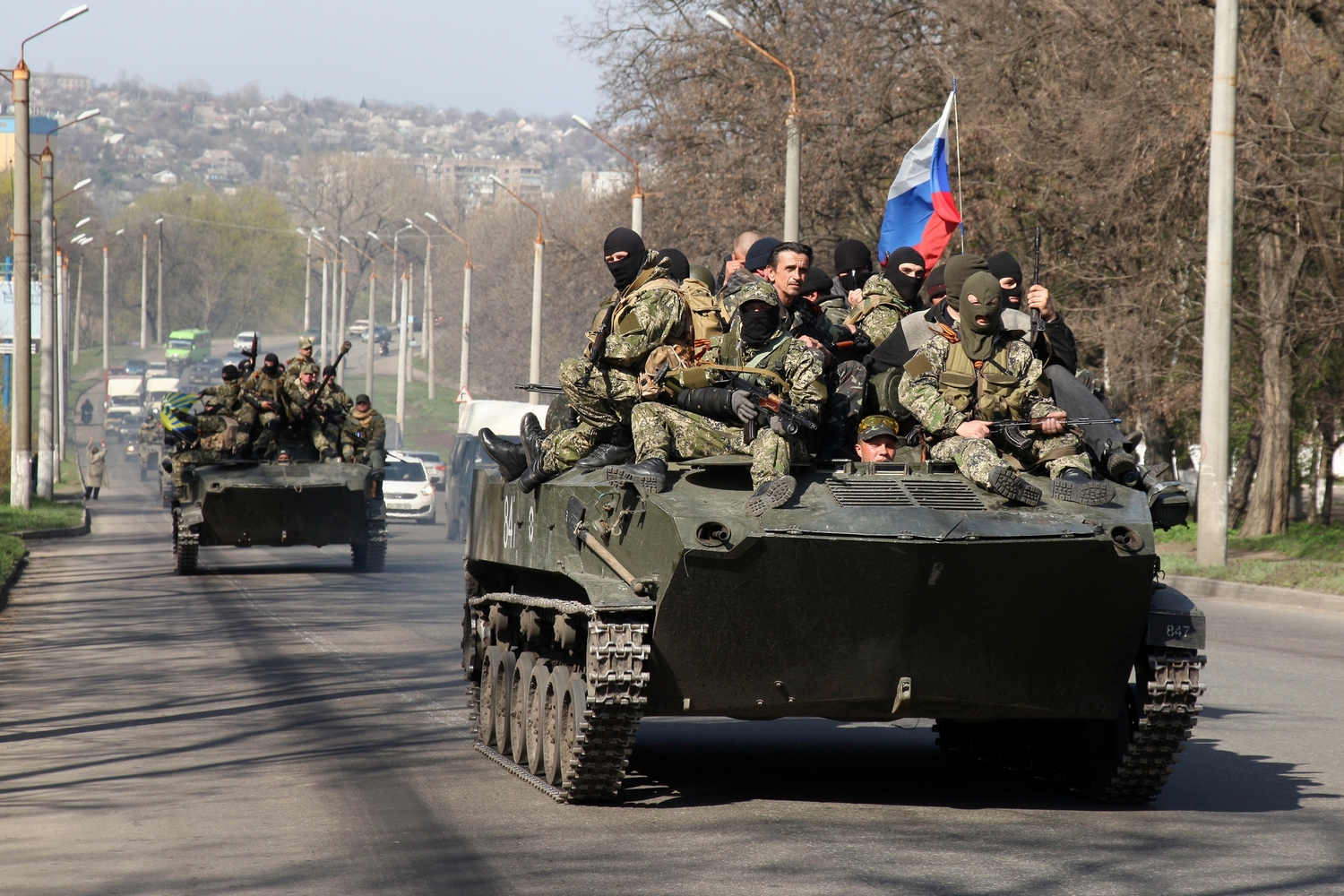
I stop the taxi and jump out, raising my camera as I move. The column is already close. BMDs rush past me, a Nona, a covered military KamAZ. On the armor of the BMDs, armed men sit packed tightly together, wearing Russian camouflage with “colorado” ribbons. Some cover their faces with masks, others look straight into the camera. Among them, I notice soldiers in Ukrainian camouflage. Some turn away, some cover their faces with their hands.
Trailing clouds of diesel exhaust, the column turns toward Sloviansk and disappears around the bend. It all happens very quickly. Just a few minutes — but the sense of shock does not go away. I try to contact the newsroom as quickly as possible to send the photos. My editor, agitated, bombards me with questions. It turns out the internet is already flooded with breaking reports: Russian tanks in Kramatorsk…
I have to “calm him down.” I say I didn’t see any Russian tanks, but Ukrainian BMDs under tricolors have moved toward Sloviansk. I quickly send the photos. Meanwhile, the news keeps pouring in.

Another column of Ukrainian paratroopers is blocked on the outskirts of Kramatorsk. A small railway station, Pcholkino, becomes known across the country. Reports say that locals with children have surrounded the soldiers there.
The first thing that catches the eye on the wide emerald field near the railway tracks is a white, torn-up Opel Astra. Its side is ripped apart, the car badly damaged. A woman is screaming beside it, two policemen stand nearby, shifting awkwardly. A little further, at the railway crossing, a column of BMDs, trucks, and Nonas stands frozen. It has jammed into the crossing like into the neck of a bottle. Some vehicles managed to pass, but now stand motionless by the roadside. Those that didn’t cross the tracks have formed a large traffic jam.
The sparkling April sun, emerald grass, blooming gardens flooding the surrounding streets — all of it creates a vivid, almost uplifting atmosphere. And in the middle of that spring brightness stands military equipment, with men, women, and children moving between it. At the far end of the field, some young men lunge at the paratroopers, restrained by others. Elsewhere, a woman hands a bag of pies to exhausted soldiers dozing right on the armor. A bit further, women with children unfold a homemade banner reading: “No to war!” People surround every vehicle, say things to the soldiers, argue here and there. The hum of a Mi-24 attack helicopter rises and falls. High in the sky, it circles again and again over the station.
Nearby, an elderly woman breaks into a wail. “Peee-ople, why do you need this Puuu-tin?! I’m from Arkhangelsk myself… there is no life there…” she cries out in anguish. “Get lost, granny…” comes the reply, and some young men shove her away under approving shouts from the crowd.
This entire space, filled with military equipment and people, buzzes like a disturbed hive. Next to one of the vehicles, real passions flare up. About fifteen furious men surround a BMD, trying to prove that the Ukrainian army is not needed here. Twisted faces, shouting, frantic gestures. The unit commander stands on the vehicle. He tries to calm them down.
Some combat vehicles, scattered chaotically near the tracks, try to break out, but the crowd immediately blocks their path. On some BMDs, the soldiers sleep right on the armor. On others, breakfast is already being laid out — soldiers’ dry rations. Above this human sea, a locomotive horn sounds. The Donetsk–Moscow train slowly approaches the station. Red carriages. The surprised eyes of a few passengers.


The roar of aircraft engines tears through the air. At low altitude, right above the tracks, a MiG-29 slices across the sky. High-voltage wires ring and sway — it seems they are about to snap and fall onto the people below. The jet roars over the tracks, the crowd, the military vehicles. The pilot increases thrust. The fighter spits out two thick trails of black smoke, then, with an even louder roar, banks sharply and climbs. After a while, it happens again. Perhaps, in the mind of whoever gave the order, this maneuver was meant to influence the crowd and somehow improve the situation for the paratroopers — but people only curse and show middle fingers to the sky. The blockade does not stop.
Time quietly passes into the afternoon. Gradually, tensions begin to ease. Locals carry black-blue-red flags of the “young republic” around the vehicles, the crowd slowly thins. Some begin to talk calmly with the paratroopers, others express their political views. A young man in a red T-shirt with the Soviet emblem immediately draws attention. He walks demonstratively between the BMDs, trying to start conversations with the soldiers. Some locals tie St. George ribbons to the gun barrels; the paratroopers, not wanting to provoke people, do not react.


Then the crowd stirs again. A Ukrainian officer climbs onto one of the BMDs. He introduces himself as Colonel Oleksandr Shvets, commander of the airmobile forces. He tries to speak to the people, but few listen. A woman climbs up beside him and actively argues something. The crowd grows. I notice a strange figure in Ukrainian military uniform with a St. George ribbon tied on.
The man climbs onto a BMD and quietly talks to the paratroopers, who seem even more disheartened after this conversation.
Dusk falls slowly. Among the crowd, I notice armed men whose uniforms differ from Ukrainian ones. Tactical vests, St. George ribbons… It is clear that war is a job for them. They surround Shvets. So these are the ones the colonel should have been negotiating with…
The crowd thins again. Strangely, there are almost no women left. It seems the negotiations are yielding some result. The vehicles with paratroopers, still surrounded, line up into a column along the tracks. The terms become clear: the column will be allowed to leave if the soldiers hand over the bolts from their rifles, and only one machine gun per vehicle remains operational. It is painful to look at the paratroopers. Exhausted, dejected, and it seems that in each of their eyes there is a silent question: why must they endure this humiliation in their own country?
A slight movement ripples through the crowd. Armed men begin pushing locals and journalists away from the head of the column. I deliberately step in front of one of them to take a shot. No doubt — he is Russian, from Girkin’s group. It is getting dark fast. He stands opposite me, almost gently cradling his rifle. I’m not sure if it’s intentional, but he slowly sways from side to side. It’s almost dark, and to get a sharp frame I have to mirror his movement. For a while, we sway in sync, facing each other. I keep pressing the shutter. He looks through the slit of his mask, as if through me, and I feel the scene could explode at any moment.
The roar of engines tears through the dusk. The exhausted column moves into the night.
Drained, on the edge of a breakdown, I call the familiar taxi driver. The “Ukraine” hotel on Shevchenko Boulevard in Sloviansk once again offers a room in the occupied town.
P.S. Much later, already at the height of the war in Donbas, one of the officers from that paratrooper brigade, after seeing my photos, said that many of the guys captured in them were no longer alive.


The events from yesterday still pound in me. Sloviansk is living a new life. The military equipment that Girkin’s special forces managed to seize from Ukrainian troops near the railway station in Kramatorsk has been placed near the Sloviansk town council. Now locals with children are there so the kids allowed climbing and playing on the armor. From the news, I learn that the Russians have taken over the TV tower on Mount Karachun.
I receive an assignment from the AFP photo chief to go to Donetsk. The rally in support of Ukraine’s unity is to take place in the evening… Exactly that. People are expected to come with national flags to show the whole world that Donetsk is Ukraine.
First, I go to Kramatorsk. One of the columns of paratroopers has managed to break through to the military airfield. It is tense there too — there has been shooting.
The road on the approach to the military airfield is blocked with bags of soil and fallen trees. Near the improvised checkpoint, a teenage girl with a St. George ribbon and an older man shift from foot to foot. Nearby I notice a telling slogan on a poster: “Yes to the referendum! No to fascism! No to NATO!” The two of them don’t react to my presence, and I walk along the blocked road toward the airfield gates. More fallen trees here. I catch a watchful glance. Someone is staring at me, slightly above the gate. I realize there is nothing more to do here.
The Kramatorsk — Donetsk bus travels slowly on local roads. The sparkling sun warms the steppe, as if a magnet attracts the eye to the Kleban-Byk tract and the waste heaps beyond it on the horizon. Islands of wild grass blooming in the fields complete the idyllic picture.
We approach Donetsk. On the left — the Donetsk filtration station, on the right — the outskirts of Avdiivka. A few years will pass, and this very place will become the site of fierce fighting, the defense of the Avdiivka industrial zone will become a legend. We run into a queue at a traffic police post. A crane is placing concrete blocks — a fortified checkpoint is being built.
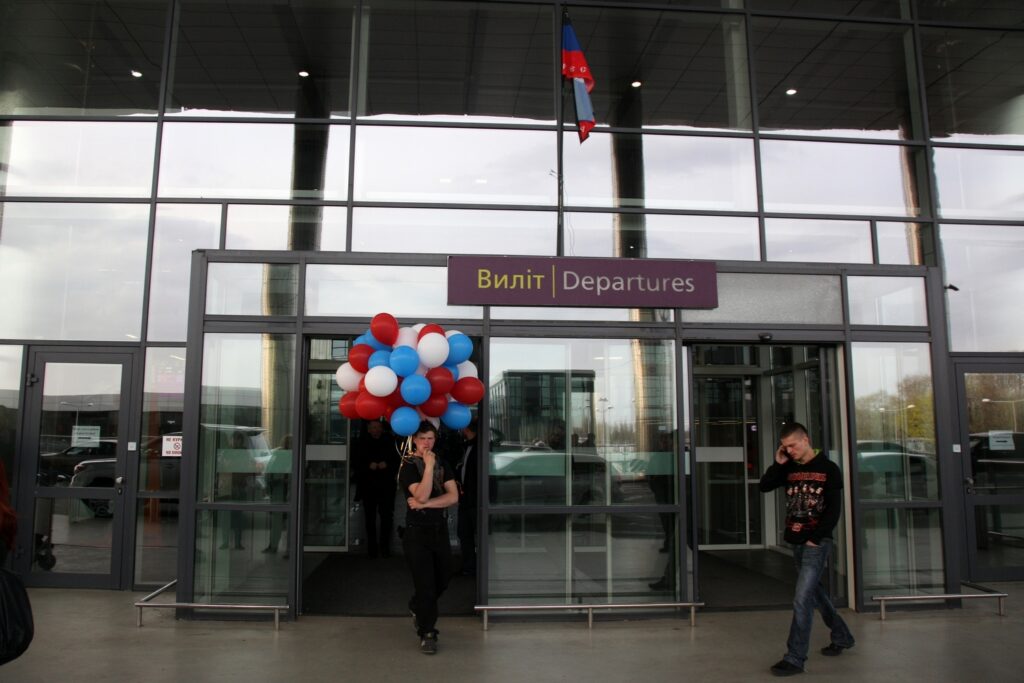
Spring is in full bloom in Donetsk too. People are going about their business, and nothing seems to echo the turbulent events in Sloviansk. In the center, I meet familiar journalists. They’re heading to the airport — reports say it has been seized by unknown men. I go with them. Everything is calm at the airport. The only reminder is the flag of the so-called DPR above the entrance and a young guy holding a bunch of balloons in the colors of the Russian flag.

On the approaches to Victory Park, there is a heavy police presence. Mounted units, special forces in helmets with aluminum shields. What strikes me is the number of people who have come to the rally. The evening sun outlines the crowd in soft light. More and more people arrive. A sea of blue-and-yellow flags, bright faces — young and old — a sparkle in their eyes. You can feel it: they came here because they had to.
The rally begins with a prayer, then the national anthem is played. People sing with feeling; some have tears in their eyes. Activists’ speeches alternate with those of politicians. Everyone is for Ukraine, everyone speaks of love and loyalty, everyone is against the destruction of the country…
I keep shooting, but inside I’m being torn apart. I want to shout to these people that in Sloviansk there are already Russians with weapons and heavy equipment, that they are ready — and will — kill…
The sharp contrast between what I went through yesterday at Pcholkino station and what I see now makes my head dizzy.
The rally ends. A huge Ukrainian flag covers hundreds of Donetsk residents. People hold it up with their hands, singing the anthem.
I walk toward the hotel. At a bus stop, young people hold a Ukrainian flag, full of energy. Someone is waiting for a bus, someone looks indifferently from the window of passing transport, someone listens to music in the evening traffic on the way home from work.
I cross the bridge over the Kalmius River. On the embankment lit by streetlights, a pedicab driver gives a ride to a mother with children, a fisherman waits for the evening bite, a group of young people strolls nearby. Donetsk sinks into a warm spring evening.


Morning. Once again, the Donbas landscapes in full April bloom flicker past the car window. News about increased security measures along the state border with Russia sparks our curiosity. Together with colleagues, we head toward the border troops stationed near the Uspenka checkpoint.
The roads are almost empty. We pass the Starobesheve Thermal Power Plant. The emerald field of wheat that stretches in front of the plant emphasizes its massive scale and raw industrial grandeur.
A corridor of slender poplars, flooded with bright sunlight, leads us to the small village of Oleksiivske, close to the Russian border.
A guard at the barrier at the entrance to an industrial base—where a military camp has been set up—lets through a group of border guards returning from the village with full shopping bags. Looks like they’ve just been to the local store.
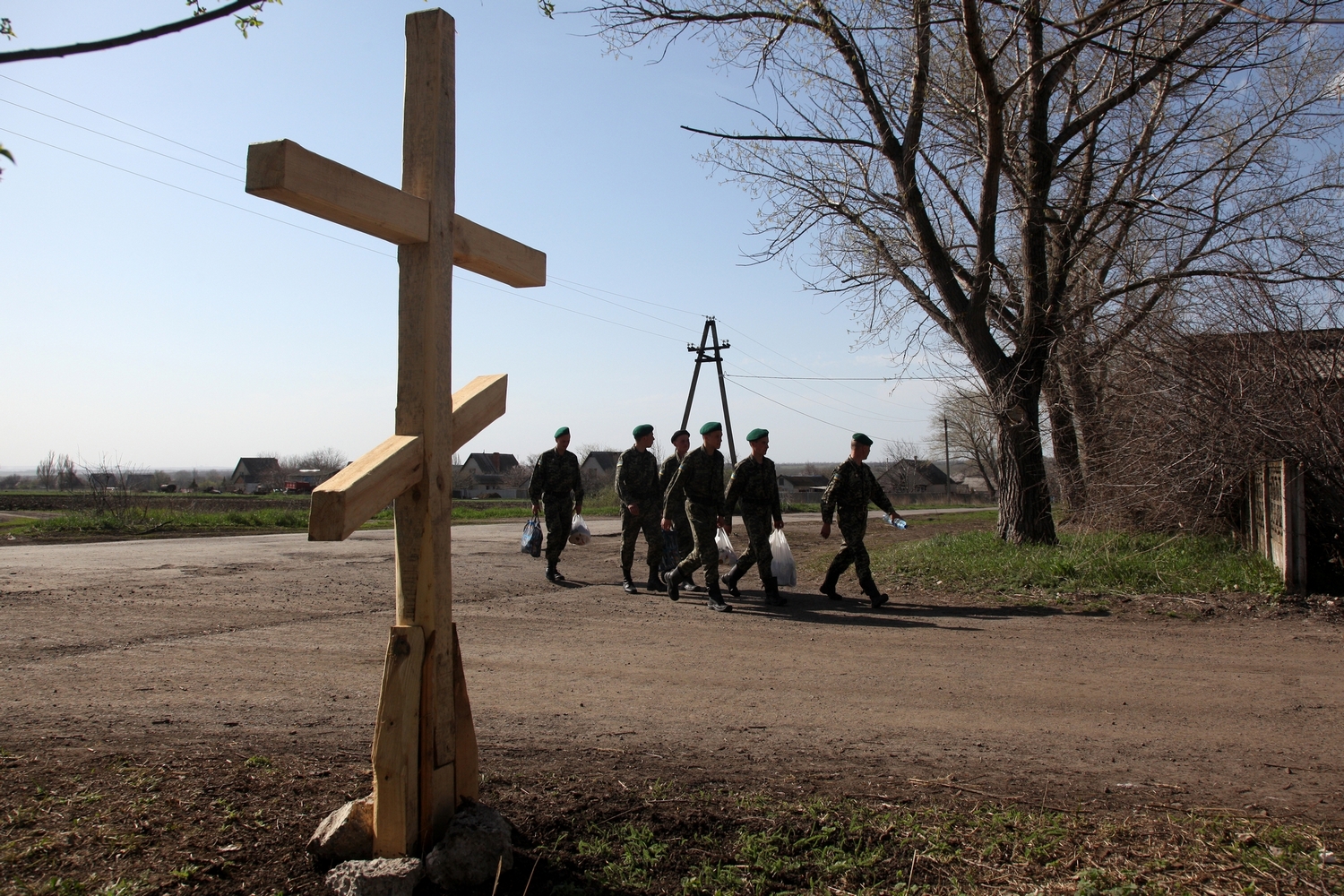
After a while, the duty officer comes out to check our documents. Then he pulls aside the camouflage net and invites us past the barrier.
Nothing unusual here on the base. An armored personnel carrier has its heavy machine gun aimed toward the entrance. Behind it, the army tents stand on a wide asphalt platform. The wash stations are located a bit further. Everything as expected in a field camp.
A young border guard is cleaning his rifle sitting on the green grass behind the tents on a spread-out tarp. The officer asks us not to film the hangars located on the eastern side of the site.
We speak for a while. He explains that the border guards are here to increase border control. Right now, a new shift is already lined up in front of the tents. The senior officer reads out the orders. The men are about to head out to the border.
The crowd gathers by the smoking area. People talk and smoke. Strangely, I notice that none of them is smiling. Serious faces, tense looks… Only a young, friendly officer smiles while seeing us off.


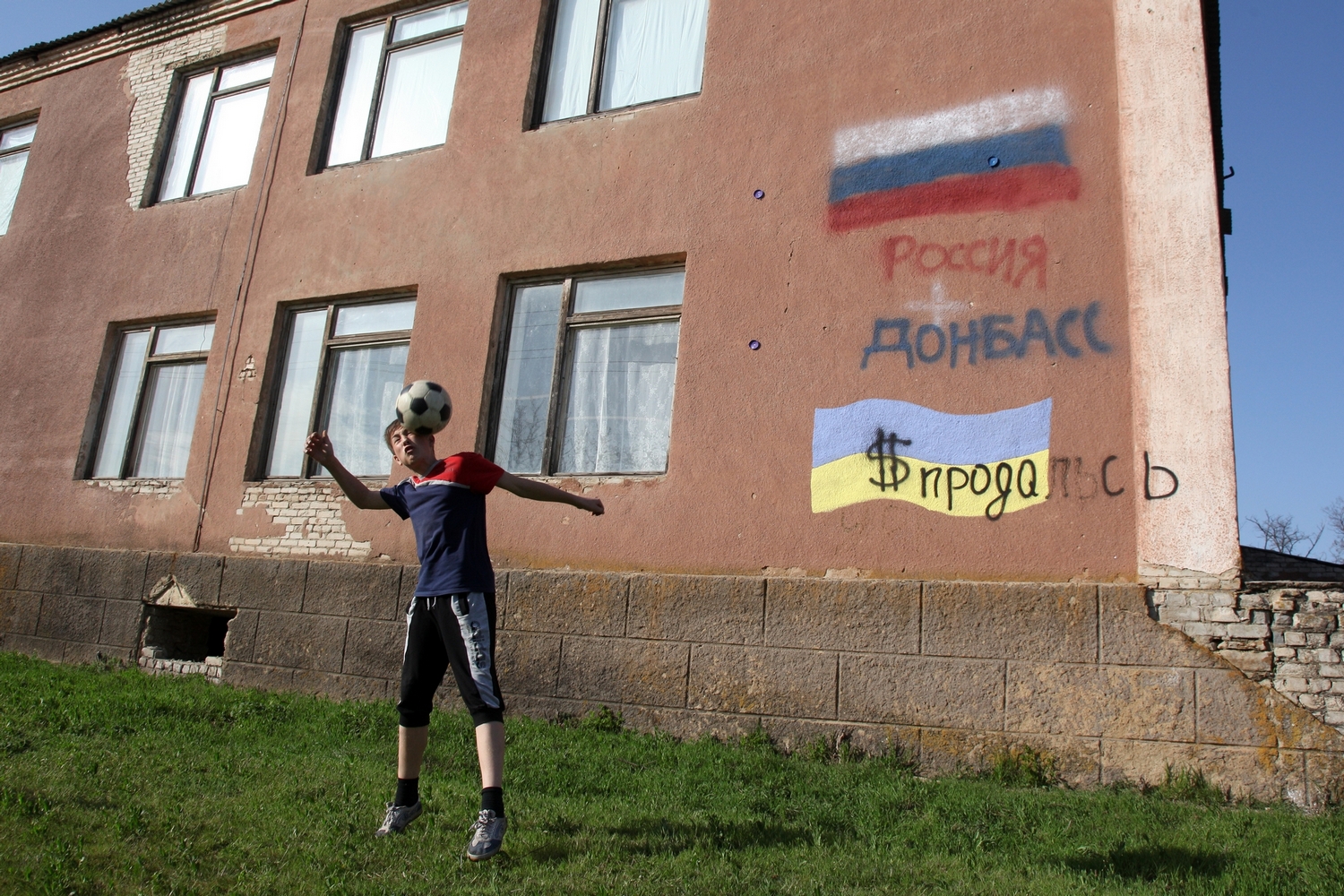
We still plan to visit the border checkpoint. We pass through the village of Uspenka. Near the local school, boys are playing football, riding bicycles. What catches the eye are the Russian and Ukrainian flags painted on the school wall—and the wording beneath the Russian one: “Russia + Donbas.” On the Ukrainian flag, written in black: “Sold out.”
At the Uspenka border checkpoint, we find only an old Moskvich car with an elderly man behind the wheel. It’s quiet and calm here.
On the road back from the border, I notice Ukrainian soldiers in a tree line. Blooming orchards in the warm light, people sitting on benches flash by the car window.
An ordinary evening.
In the morning, I’m on the road again. Strange news: the runaway ex-president Viktor Yanukovych is supposedly planning to arrive in Donbas to lead resistance against Kyiv. It sounds like a fake, but the agency has to react. I shall go to the Azov Sea coastline. Allegedly, that’s where the “arrival” is supposed to happen…
I start with the village of Sedove. Empty resorts and holiday bases. A deserted coastline in Novoazovsk. Mariupol. It feels like the town is holding its breath, waiting for something unknown. And nowhere is there any sign of activity that would suggest the runaway’s arrival.
The first Ukrainian checkpoint appears on the approach to Berdiansk. Young conscripts from the Internal Troops reinforce the checkpoint with sandbags and check the vehicles.


Berdiansk is quiet, almost unusually cozy. I go for a walk along the evening promenade. There are few people around. And then—unexpectedly—at full volume from a restaurant comes music by Okean Elzy. And Ukrainian flags are everywhere!
The air brings a gentle scent of the sea. Fishermen are catching gobies. People around walk dogs, bring children to the amusement park. April 16 still hums in my head like a heavy hangover. In an attempt to shake off those feelings I buy a ticket for the Ferris wheel.
The cabin slowly climbs upward, opening up the horizon. The sun has already set, tinting it with a soft pink glow. Ragged clouds drift across the evening sky. Lights flicker on in the port. The scene brings a sense of calm.
Back at the hotel, I scroll through the news. And then one hits hard: fishermen have found the bodies of brutally tortured men in the Kazennyi Torets River. One of them was a deputy of the Horlivka town council, Volodymyr Rybak.


A gloomy morning. An empty embankment. A fishing boat far out at sea looks like a toy. The quiet sea and sky offer every shade of gray. Near the water, the air smells of seaweed and iodine. A slightly drunk fisherman is kissing his little dog, holding it tightly in his arms. “Gotta sober up a bit, or my wife won’t let me home,” he jokes.
I sit nearby for a long time, not wanting to leave.


An overcrowded bus departs from the Berdyansk bus station. I manage to get a seat by the window. Mariupol fades behind me. A stone steelworker statue bids farewell with empty eyes.
A light rain falls over the endless steppe. Shelterbelts, islands of blooming blackthorn, green fields of wheat are seen through the glass, covered in rain droplets. Through the glass covered with raindrops, the forest strips, islands of blooming thorn, and green fields of wheat pass by.
Donetsk city is ahead once again.

Morning. Once again I walk along Shevchenko Boulevard toward the Oblast State Administration building. At the intersection with Artem Street, I go down into an empty underpass. From afar, the sound of music drifts in. The echo of the passage amplifies a painfully familiar melody that sends a rush through me. Hutsulka Ksenia.
Clear young female voices—just a few hundred meters from the barricaded administration building. Two girls are playing guitars and singing a Ukrainian song. A few passersby hurry past and climb the stairs to the street. Shocked, I stand still, catching every word, struck by their courage, studying their determined faces. As the last chords fade, I go back up.
Near the administration, everything is as before. Elderly women by the barricades, young men in masks with St. George ribbons, a variety of flags from different Russian political groups, tricolors, the “DPR” flag… It feels as if life here has slowed down and preserved this camp in place.

For a while, I wander, trying to capture something. Drifting from one side of the camp to the other. I circle the building in search of a shot. Returning to the square, I suddenly catch the sound of a piano. What a strange thing.
A piano? Here?
A crowd has gathered in front of the barricades. I push my way in. Yes—a piano! People surround a platform with the instrument, at which a young man, clearly not local in appearance, is seated. As a sign of “loyalty,” a Russian flag is taped to the side of the piano, and the young man carefully plays a well-known melody. Then another.
The crowd from the barricades drifts closer. People gather tighter around the performer.
It’s Davide Martello—a musical ambassador of peace, as he calls himself. A German musician who has made it his mission to play in places of resistance or unrest, where tension is rising and blood may be spilled. He played his piano at Taksim Square during the protests in Turkey in 2013.
Now he is playing here—in front of the Donetsk Oblast State Administration. More and more people gather. A man in camouflage even requests a tune.

The performance is interrupted by young men with “DPR” flags stuck to their chests. For a moment, the pianist doesn’t understand what they want from him. The police have to step in.
The performer explains his good intentions to journalists from Russia Today, who are also working there. But the guards at the barricades are adamant, and Davide moves a bit further away with his instrument.


The concert doesn’t last long. The same young men again tell the pianist to leave. To avoid stirring up the crowd, the police advise him to do the same. The man is essentially driven away from the administration building.
The camp sinks back into its everyday rhythm. People talk calmly. Children play on the barricades.


Today, local activists promise to raise the Ukrainian national flag on the building of the Vostok-Media information center in the central square of Donetsk. A very bold act for Donetsk in April 2014. The reaction from pro-Russian forces does not take long.
Nine in the morning. People with Ukrainian flags have already gathered near one of the oldest buildings in central Donetsk. Bright, smiling, cheerful. Passersby hurry past, the city lives its own life. People with St. George ribbons approach the activists — arguments spark, conversations unfold, but for now everything remains peaceful.


I notice a group of young men beginning to gather near the Lenin monument, across from the demonstrators. Some of them wear masks, many carry Russian flags. A Zaporozhets painted in the Russian tricolor pulls up. The guys wave the flag and start provoking the Ukrainian activists from across the street. In response, slogans rise from both sides. The police officers stand behind the pro-Russian group, clearly not of low rank.


This standoff across the street continues for some time. I move over to the pro-Russian side. Everything feels predictable, but the mind searches for something beyond the obvious.
The city keeps moving. People get to work by trams and minibuses.
There it is. I watch the faces in the passing transport. Their reactions matter. Surprised, uneasy looks. Tense expressions, worried eyes. Yes, there are indifferent ones — but I do not see a single face that looks pleased with what is happening near the Lenin monument.

The media center is closed, and the Ukrainian flag cannot be raised. The most aggressive pro-Russian activists cross the street. Some arguments escalate, voices rise. I take several shots during one of these exchanges.
A well-known Ukrainian journalist and politician from Donetsk, Serhiy Harmash, and a local man, Oleksiy Haronin. They still stand face to face, arguing passionately. Very soon, there will be no more arguments — tanks, artillery, mortars, and rifles will speak instead. Haronin (Gnom) will later fight against Ukraine in the unit of the St. Petersburg neo-Nazi Milchakov and will be killed on January 22, 2015, near Avdiivka.

The tension gradually fades. I head toward the barricades at the Oblast State Administration building.
The camp is buzzing. There is information that Ukrainian politician Yulia Tymoshenko may come here today. Supposedly, she is already in Donetsk. The defenders of the camp prepare to repel the “Kyiv guests.” Young men in camouflage and tracksuits, armed with baseball bats, group up near different approaches to the building. The atmosphere grows electric. It is striking how the police here, too, remain loyal to those with bats, St. George ribbons, and Russian flags on their clothes. Masks cover their faces; there is a sense of discipline and organization.


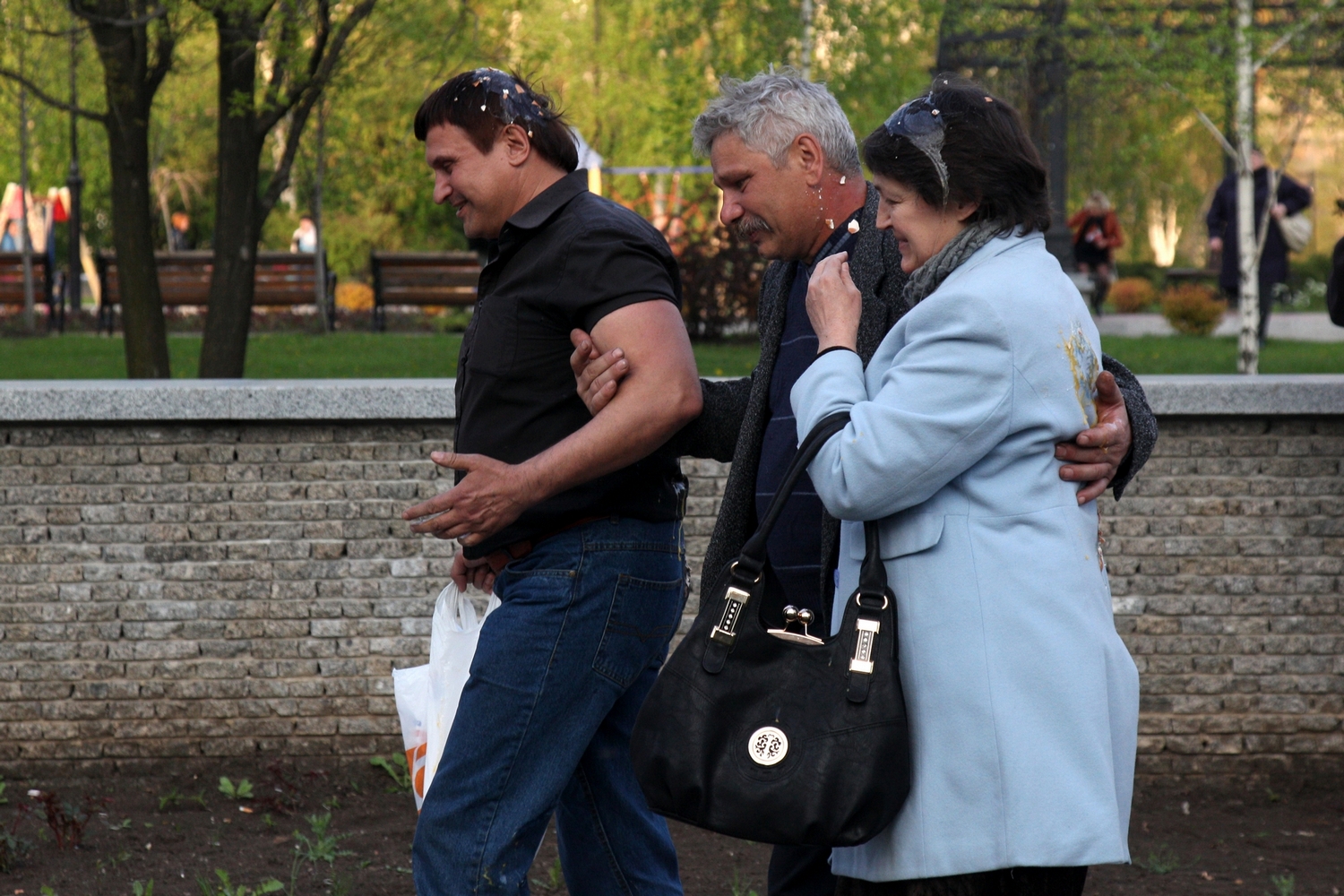
Evening falls. And here they are. The crowd rushes toward two men and a woman who have just stepped off a trolleybus. I don’t even know how they are identified as Tymoshenko supporters, but the perimeter guards aggressively push them away from the administration building.
Eggs start flying. The three are pelted and driven away from the building. They do not resist — they simply retreat under the rain of eggs.
After moving some distance away, covered in yolk and shells, the three give interviews to several TV crews. That’s it. The visit of one political force to the camp of the “young republic’s” supporters can be considered over.
Exhausted, I head back to the hotel. Tomorrow we go to Mariupol. Another rally in support of Ukraine’s unity is planned there.
Mariupol greets us with factory chimneys propping up the spring sky with columns of gray smoke. We pass the stone steelworker. Life in the city seems calm, almost routine. We head straight to the City Council building, seized by supporters of the “young republic” back on April 13. Here too—barricades, “DPR” and Russian flags—but very few people. A sense of stagnation hangs in the air.
Right in front of the barricades—an improvised memorial. On a table, two men’s portraits with black ribbons. Around them—candles, flowers. On the evening of April 16, while a crowd and Russian special forces were blocking paratroopers near Kramatorsk, an attack was carried out on a National Guard unit in Mariupol. It was surrounded by pro-Russian protesters. Molotov cocktails were used, then shooting began, and these two men were killed by gunfire.
A small group of pensioners sits on chairs near the memorial—almost like resting in a park. On the playground by the City Council, not far from the barricades, children are playing. It’s warm, springlike.
There is still plenty of time before the rally for Ukraine’s unity, so we walk around the city. Sunlit, clean, wide streets, and this calmness—this is what stays with me from that day.


The square in front of the drama theater is filled with festively dressed people. Blue and yellow dominate here. Ukrainian flags everywhere—in hands, over shoulders, ribbons woven into girls’ braids. People are holding a long Ukrainian flag stretching across the entire square. Inspired faces. Many youth and children. It feels like they came here at the call of their hearts. The square glows with energy.
The National Anthem, sung by a thousand voices, floats over the city center. The girl in the national wreath seems to radiate light. I can’t take my eyes off her. I keep pressing the button, taking photos again and again.
The rally lasts more than two hours and is held under police protection. As people start leaving, my attention is drawn to a group of young men with «colorado» ribbons, blocked by police near one of the buildings on Peace Avenue—then Lenin Avenue. With anger, they shout at the police: why was this gathering of “fascists” allowed in the city?


Many years have passed since that day, but Mariupol has forever remained in my mind with the image of that girl in the wreath, singing the anthem by the drama theater.

Horlivka. A quiet neighborhood. Neat houses sink into blossoming gardens. Near one of them, people have gathered. Grieving faces, lowered eyes. In the yard, on stools — a coffin.
The sound of a hammer draws attention. A grey-haired man is nailing a plaque onto a wooden cross.
“Rybak Volodymyr Ivanovych. 30.11.1971 — 18.04.2014. Remembered, loved, mourned.”

The yard is quiet. Only soft crying and the careful steps of those present. A grief-stricken woman in a black headscarf gently holds in her hands the bruised and battered hands of the deceased. Another woman, a bit younger, cries beside her.
Today they are burying Volodymyr Rybak, a deputy of the Horlivka Town Council. He disappeared on April 17 after a pro-Russian rally in Horlivka. Witnesses said that after the rally, Rybak had gone to the town council building to take down the black-blue-red flag, after which a group of masked men blocked him.
His body was found on April 19 in the Kazennyi Torets River together with another murdered man — a Kyiv student, Yurii Popravka. Both bodies bore signs of brutal torture.
For the first time, I am filming a funeral this close, and I feel deeply uneasy about touching someone else’s grief, when the relatives seem so defenseless. The women stroke the burned and disfigured face. It is hard even to imagine what this man went through before his death…
The priest goes through the funeral service, and the people slowly begin to leave the yard.
One thought does not let go: he was killed on his own land.
I try to leave as quickly as possible.


I wander around the barricaded Donetsk Oblast State Administration building. I feel totally drained and have no intention of photographing the depressing camp of the “young republic” supporters.
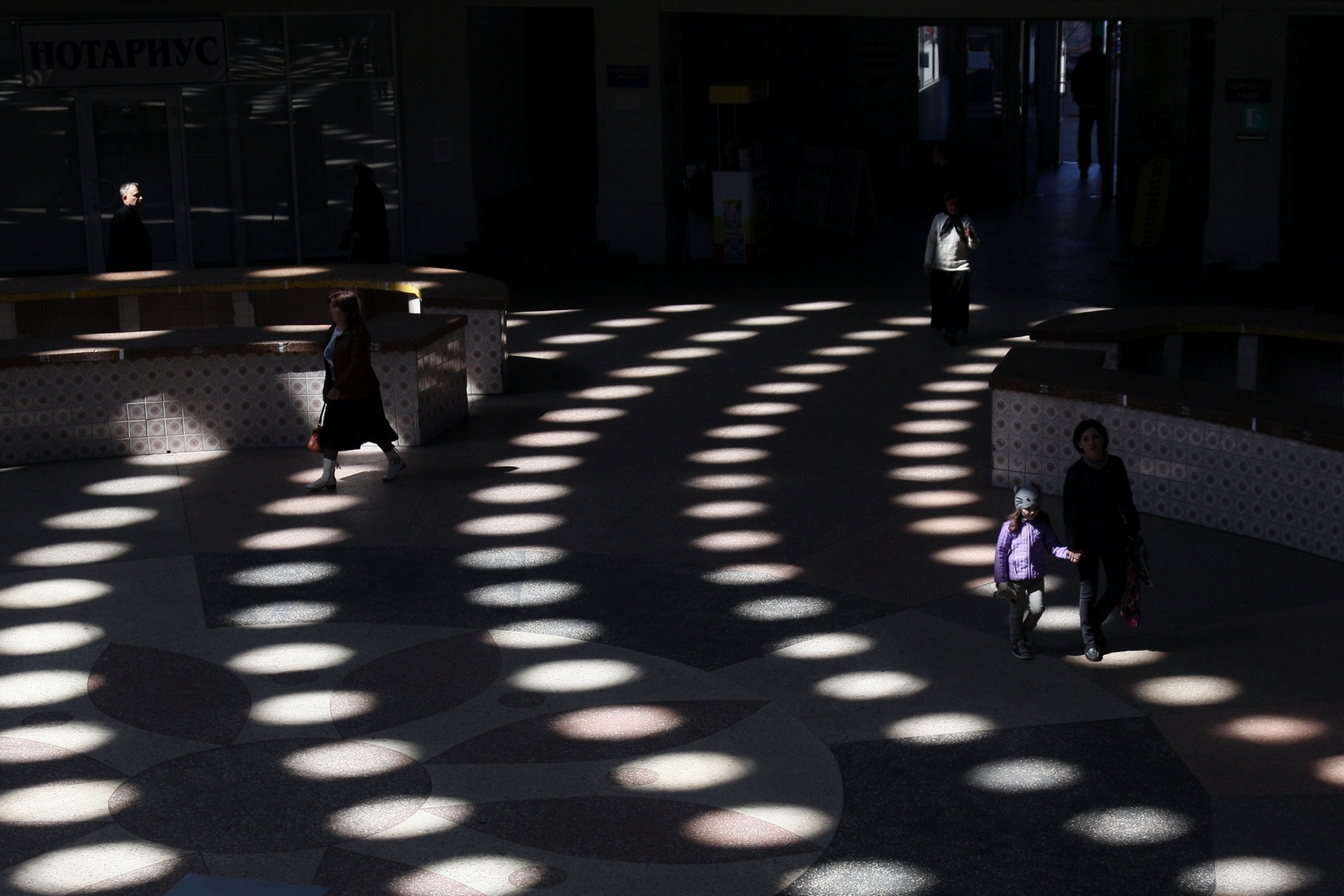
Of that day’s photos, only one scene stays with me — at the market.
A play of light and shadow.
Today I’m to meet volunteers of the newly formed “Donbas” battalion, and go there with a journalist. Information about the recruitment to defend the unity of Ukraine has been circulating on the Internet for quite some time. Finally, we manage to agree on a visit to their training camp. The meeting point is set at the bus station in Krasnoarmiisk (now Pokrovsk).
In the taxi window, sights flicker one after another: Pisky, the dam in Karlivka, the turn to Selidove, the “Russia” mine, and the endless steppes behind it. The slag heaps near Novohrodivka rise in the distance beyond the tree lines like Egyptian pyramids. Sun-warmed, these are the typical landscapes of Donbas. If only I had known then how many times I would see these places in different seasons, and how much I would become tied to them.
The taxi drops us off at the station and leaves. Here we switch to another car. For a long time, we drive along empty narrow roads with overgrown roadsides. Hardly any oncoming traffic. The driver says we are already in Dnipropetrovsk Oblast.
Here is the destination. An ordinary mechanized column in a small village somewhere on the border of Donetsk and Dnipropetrovsk oblasts. We are greeted by a large Ukrainian flag on the wall inside a one-story building. Next to it — a duty guard in black overalls and a balaclava. Nearby is a sleeping area with neatly made bunk beds.

After a brief conversation with the commander, who asks not to be filmed, the volunteers begin training. Several men in black overalls and balaclavas assemble and disassemble an assault rifle, then, under the instructor’s command, move on to exercises.
The instructor is clearly a former soldier with military experience. He drives the recruits hard — endurance exercises, hand-to-hand combat, assault maneuvers. Like a hawk, he moves among them, correcting, refining every motion. Burning eyes, eagle’s nose.
Upon completion of the training, he confirms it: he is Georgian. As a young man, he fought against the Russians in Abkhazia in 1992–1993. Now he wants to pass on his experience here.
We are truly impressed by the determination, the spirit, the resolve of these people.
It’s time to return to Donetsk. We are driven back to Krasnoarmiisk, where our familiar taxi driver is already waiting.
The feeling doesn’t leave me — that I have seen a new force. Uncompromising. Ready to defend the country.


P.S. In the spring of 2019, at positions near Donetsk, I recognized him — the same eyes, the same eagle’s nose. Zurab Yashvili.
He has been fighting again.
Later, over tea in a basement at the Butivka mine, we had a calm conversation. On 24 February 2022, he once again volunteered.
In July 2024, Zurab died from war wounds.

Sunday. The small hotel on “50th Anniversary of the USSR” Street slowly wakes up. Thin walls between rooms do not hold back the noise that seeps through. It feels like the whole hotel is buzzing like a hive. Strangely, just a few days ago it was almost empty. Today it is full of people. They talk, shuffle in their rooms, kettles hiss. Today there is a big rally in the Donetsk city centre.
It is warm outside, in a spring-like way. I quickly make my way to Lenin Square. It is crowded. A stage has already been set up under the monument to the “leader of the world proletariat,” guarded along its perimeter by masked men. Powerful speakers blast Soviet songs. In the tents of the Communist Party of Ukraine and the Party of Regions, propaganda leaflets are being handed out.
But the number of Russian flags is the first thing that catches the eye.

Ah, familiar faces. The elderly women from the camp near the Oblast State Administration are already here. Dressed up. “Colorado” ribbons, “DPR” flags.
Speakers talk, calling for a referendum. The crowd gets agitated, people wave flags, applaud — there is a sense of festive excitement. At the end, the self-proclaimed governor of Donetsk, Denis Pushilin, takes the floor.
The key message of the speeches is the referendum scheduled for May 11. Words about “sovereignty” and the possibility of joining any country trigger enthusiasm. Russian and “DPR” flags rise into the air again.
The rally comes to an end. Happy faces, sheer excitement. A call to march to the state television and radio company comes from the stage — the voice of the “young republic” must be heard.


While I sit in McDonald’s sending photos to the newsroom, the square empties completely. I catch a taxi. I need to catch up with the head of the column that has already moved onto Kuibyshev Street.
I jump out of the car at the intersection of Lenin Avenue and Kuibyshev Street. In the distance, a wide column of young and determined supporters of the “young republic” slowly approaches along the avenue. Behind them — a traffic jam. A tram nervously rattles its bell. The column turns onto Kuibyshev Street. At the front — men in bulletproof vests, with police shields and baseball bats.
Here is the state television and radio company. A majestic building with massive columns is tucked into a park. The gates are closed, and the crowd presses against them. A group of armed police officers, seeing the mass of people with bats and shields, slowly withdraws behind the corner of the building. As soon as the last officer disappears — the gates open under pressure.
Like a stream breaking through a dam, the crowd fills the yard and the stairs.
Police officials try to negotiate but all in vain. Only one officer remains at the entrance. He is simply pushed aside, and the crowd floods into the lobby.
It is 16:52 on the watch.
That’s it. The “young republic” gets its mouthpiece.


An overwhelming urge to drop everything and go home beats in my temples. I hail a taxi. We drive through sunny Donetsk, and I listen to the driver’s stream of thoughts. He likes everything. “Never mind, our children will live a little longer without Coca-Cola,” he says.
I object that Donbas will hardly be able to exist without Ukraine. He dismisses it easily and says he is not against returning to the USSR.
There are tickets available for the evening train to Kyiv. I quickly pack and leave the hotel.
The wheels hum steadily. Outside the window, spring Donbas flickers by. Thoughts swirl chaotically in my head, and like in a distorted kaleidoscope, all I have seen over these 20 days flashes before my eyes…
P.S. I never returned to Donetsk.
The next day, the last large pro-unity rally took place in the city.
It was dispersed by pro-Russian forces.
People were beaten with metal bars.
Kyiv is warm and noisy. The city is still recovering from the turbulent winter events. For the second day, I wander around the apartment. My head is buzzing. All my thoughts are fixed on Donbas. The news from there brings no calm. The day before yesterday, the day I returned, a “people’s mayor” appeared in Sloviansk — Vyacheslav Ponomaryov. Yesterday in Luhansk, masked men with Russian flags seized the Oblast State Administration building.
Another report of a bomb threat is no longer a surprise. Kyiv-Pasazhyrskyi railway station is “mined.” I go there.
The main building is empty. Police, red-and-white tape, tired and nervous passengers. After Donetsk and Sloviansk, all of this somehow feels normal. An hour later, the station reopens, and people gradually return.
Life surges again.
In the coming May, the bomb threat reports routine.


Deep night. Kyiv is immersed in blooming chestnut trees. The growl of APCs in the government quarter is oddly reassuring. I’ve been waiting all day for these exercises. Today, fighters of the State Guard Department and soldiers of the Armed Forces of Ukraine practice coordination in case of the need to defend state institutions.

And again — Sloviansk and Donetsk are in my head. And Russians on APCs in Kramatorsk.
The guys in new “Dubok” camouflage, with bayonets strapped to their body armor, spill out of the covered truck bed. APCs pull up to the walls of the Verkhovna Rada, and the soldiers form a chain along the perimeter. Tense, anxious faces.
Special forces with machine guns are already in position at the entrances to the parliament.
Snipers take their designated spots.
The same scene unfolds near the Cabinet of Ministers building. Empty streets of a sleeping city. I’ve never seen so much military equipment around these institutions before.
The feeling doesn’t leave me — that these preparations are meant to be seen by those in Donbas who are establishing their own order.
The thought that tomorrow I need to buy a ticket to Donetsk keeps drilling into my head…


The morning news feels like scalding water.
Fighting in Sloviansk. Two Ukrainian Mi-24s have been shot down. One of the crews has been killed.
I buy a train ticket to Donetsk and hastily pack my things.
Closer to noon, disturbing news comes from Odesa — clashes with gunfire in the city center, near Soborna Square. People were killed.
The head of the AFP Photo Service, Serhiy Supynskyi, calls and advises me to wait until the evening before deciding where to go. Possibly — Odesa…
The departure time of the evening train to Donetsk is slowly approaching. Finally, the decision is made — I have to go to Odesa.
I get ready. The central bus station is just a stone’s throw away. Luckily, there are still tickets for the night bus. Deep down I feel a sting of dissatisfaction. I want to go to Donbas so badly — that’s where it’s hottest now.
I stand in front of the bus and, to silence my doubts, take out the ticket to Donetsk and throw it into a trash bin.
Dusk falls. Boarding is almost over. I am already on the bus. I press my forehead against the cold glass.
Serhiy calls again.
The news shocks me: more than forty people are already dead in Odesa…
Some kind of madness.
I close my eyes.
The bus drifts into a sleepless night.
I wake up from my half-sleep to the sound of wheels. A straight road dissolves into a pale pink horizon. In the morning twilight, the bus descends toward Khadzhibey. Odesa is very close. The thought of what I am about to see keeps me from sleeping the whole night. My mind refuses to grasp the scale of what has happened.
Five in the morning. A gentle dawn floods the empty streets of Odesa. I leave my things in a hotel room on Gretska Square. Yesterday, not far from here, participants in a march for the unity of Ukraine were attacked by pro-Russian radicals. The first shots rang out. Ukrainian activists were killed.
I step outside. Near the Afina shopping center — a burned-out minibus, a silent witness to yesterday’s events. I call a taxi and go to Kulikovo Field, where angry pro-Ukrainian demonstrators had driven supporters of the "Russian world" the day before.
The May sun already rules the streets of Odesa. Total chaos reigns over the large square in front of the Trade Unions Building. Remains of half-burned tents, stones, and all kinds of debris are scattered around. The charred doors of the main entrance frame a black hole of a lobby. The cracked, soot-covered glass of the second-floor windows stands out.
Three policemen hide their faces when they see the camera. They sit on stacked pallets in front of the entrance. It is not possible to get inside: investigative actions are underway.
I walk around the House of Trade Unions in a circle. Side doors are smashed, and there is also a police cordon there. In the park, on the paths — puddles of dried blood, bandages, rubber medical gloves, small icons; a bit further in the bushes — a bloodstained Ukrainian flag. What on earth happened here yesterday?..
Near the exit from the yard — a line of riot police in gear. On the northern side, exhausted officers are smoking around a fire. The entire building is blocked off around the perimeter.


On the square in front of the main entrance, municipal workers are already at work. A tractor scrapes together the remains of the burned tent camp. The entrance itself is guarded by a chain of riot police. Nearby, a priest prays with tears in his eyes. A woman with flowers cries in front of the entrance. She is allowed to place her bouquet by the wall of the building. Grim rescuers, just out of the building, roll up a fire hose. There is a palpable sense of shock and confusion among all those present...
7:30 a.m. I send the first photos to the newsroom.
9 a.m. After a sleepless night on the bus, fatigue creeps in. The sun warms, and I want to sleep. More people are arriving. They bring flowers, light candles. The sun-worn police officers don't interfere.


Suddenly, angry shouts spread across the square in front of the Trade Unions Building. My attention is drawn to men in camouflage and body armor. On one of their patches I notice the words: “Freedom or Death!” While the young men are being checked and allowed through the police cordon, the crowd becomes electrified.
A large stone hits a policeman in the leg. Women and men with “colorado” ribbons wave sticks and move forward. The level of tension is clearly rising. The most agitated are already swinging sticks in front of the police.
But the crowd finds another way to vent its anger. The large Ukrainian flag that had been flying on the flagpole in front of the building falls to the ground. It begins to be trampled into dirt and ash.
And then something happens that forever changes my perception of Odesa.
I have visited this city often and love it very much. But the remnants of imperial gloss always created dissonance in my mind. The pro-Russian sentiments of some of its residents were unsettling. It was they who had gathered here now, trampling the Flag of my country into dirt. After what I had just seen in Donbas, everything inside me turns upside down.
A young man appears as if from nowhere. He snatches the flag from under their feet and tries to run. It is an act.
The enraged crowd attacks him. Fists and sticks come into play. Probably, if not for the police nearby, the young man would not have survived… The officers literally pull him away and lead him out of the square.
Another man immediately grabs the flag, but he too loses the struggle. The flag is back underfoot. It is set on fire. This clearly energizes the pro-Russian demonstrators. They wave their fists and chant slogans.
Surprisingly, there are still brave ones who try to argue with the crowd. Clashes flare up here and there, and groups of police rush about, trying to pull the desperate ones out. They are also taken away.


The tension is rising. People are already pressing against police shields. The crowd forms a wedge, trying to break through the center of the cordon and get into the Trade Unions Building. In front are the stubborn women. The police do not touch them. The brawling men are getting into fights here and there. Before my eyes, one attacker lifts the visor of a policeman’s helmet and punches him in the face. A little further, the crowd pulls an officer out of the line and throws him to the ground. Cries and shouting come from everywhere. His colleagues pull him back and save him from the furious mob.
The police manage to hold the line, and the passions gradually subside. The crowd retreats. There are more people on the square now, but the open aggression fades. People continue to bring flowers to the walls of the Trade Unions Building. Many are crying.


Tension again. A young woman stands surrounded by people clearly not pro-Ukrainian and tries to speak: “People! We’re being set against each other! Come to your senses!” Her words drown in mockery and jeers. Some begin to clap right in front of her face.
Then she takes a deep breath, raises her hand, and shouts: “Glory to Ukraine!”
Instantly her blond hair is in someone's fist. They pull her by the hair and try to beat her. Fortunately, more moderate people intervene, pull her away from the crowd, and lead her out of the square.
Near the center of the police line, opposite the entrance to the building, there is movement. The crowd parts, and priests line up in the space created. They begin a memorial service.
I leave the square. People walk toward me carrying flowers and candles.


P.S. There was some good news — paratroopers, together with the National Guard, took back the TV tower on Mount Karachun near Sloviansk.
Mourning.
Nearly 50 people dead.
The mind still refuses to accept such a number of lives lost in a single day in the seemingly peaceful city.
A gloomy morning. I walk toward the Duke monument. Ukrainian activists are holding a memorial there for those killed during the unrest on May 2. There are few people. An elderly woman stands out, holding a handwritten sign addressed to the Russian president.
The speeches are short. The national anthem. Someone is crying…
That’s it. I need to go to the Trade Unions Building.
On my way, I meet two young guys with bats and Ukrainian symbols. Probably security for the rally.


Hundreds of people on Kulikovo Field. There is a commotion at the entrance to the House of Trade Unions: workers are removing the charred door. A few policemen linger nearby. Word has spread that today people may be allowed inside.
There is a mountain of flowers on the square in front of the entrance. People keep bringing them, lighting candles and lamps. On the steps, in the center, a stand reads “Remember Khatyn,” and, oddly, there is a portrait of Slobodan Milošević with a quote about the “triune people” and the destructive influence of the West. The combination feels strange. Nearby is a stand with lists of the dead. A little further, on the wall of the Trade Unions Building, is an installation with a large tricolor and an icon of the last Russian emperor. Everywhere are mountains of flowers, candles, and lamps. Sometimes a wave of crying rolls through the square.


Around 1:30 p.m., the police step aside, and people cautiously begin entering the lobby. I go inside too.
The hall is dark, there is a strong smell of burning. Broken plaster crunches underfoot. The first thing I see is striking: the bricks on the walls, the concrete, the ceiling — all are white, baked as if in a furnace, up to the second floor. It is difficult to imagine what hellish flames raged here on May 2.
Only footsteps can be heard. In almost complete silence, people with candles and flowers climb the stairs. On the second floor, there are sooty walls and darkness. Someone is crying quietly, someone stands with a candle, lost in thought. Like pale shadows, people move through the dark corridors.
I climb to the smoke-stained third floor. On the stairs there is a pile of charred furniture. These barricades must have cost someone their life... The stairs, the walls — everything is blackened to the top. Black silhouettes, the shuffle of footsteps, sobbing.
People are crowded together in one of the branching corridors. There are lamps on the floor. Nearby, women in black headscarves are crying. These are relatives. It seems that the air in the soot-covered rooms is thick with grief.
I walk through the corridors of the third floor. All the doors to the offices are wide open, the contents of the cabinets and tables are scattered across the floor. I find a room with a lock so that I can work on sending photos to the newsroom. Not even ten minutes pass before someone starts trying to break down the door from the outside. Clearly, not everyone was brought into these walls by mourning…
Outside, the street gets crowded. I hear calls to go to Tiraspolska Square to “free the boys.” Some of those present head toward Preobrazhenska Street, where pro-Russian participants in the May 2 events are being held in a detention center inside the city police department.


It starts to rain. Twenty minutes on foot and I’m there.
The gates of the police building have already been broken down. An agitated crowd fills the yard. Emotions are running high. Pro-Russian participants in those events are walking through the crowd straight toward me. The police just let them go. Hugs, shouts of joy, tears. Their relatives are welcoming them as winners. Near the exit from the detention center, police officers watch the scene with stone faces.
On Preobrazhenska Street, in front of the building, a spontaneous rally begins. “Odesa is a Russian city! Russians don’t abandon their own! Heroes!” the crowd chants under a rain-soaked Russian flag. No one seems bothered by the line of riot police edging closer, trying to push into the yard. Protesters tie St. George ribbons onto the officers’ gear and call on them to join the “people.” Participants in a religious procession with icons and banners are also here.


“Right Sector is coming!” — a frantic screaming as a shot is fired.
What happens next is amazing and shocking at the same time. Everything is set in motion. Within five minutes, the street in front of the police building is empty. As if no rally had taken place here and no passions had been raging.
It feels as if Odesa has frozen in shock. The city has quieted, as though hiding under the weight of grief. Neither before nor after that May had I seen the streets in central Odesa so empty.
Today is the funeral of Vyacheslav Markin, a member of the Party of Regions and a deputy of the Odesa Oblast Council. He died on the night of May 3 from injuries reportedly sustained after a fall from a height.
The large administrative building of the Odesa Oblast Council at 83 Kanatna Street stands directly opposite the Trade Unions Building. The walls of the second-floor hall are covered with heavy cloth. People gather around the portrait of the deceased, which is held by a funeral worker. At about 10 a.m., the coffin with the body is brought into the hall.
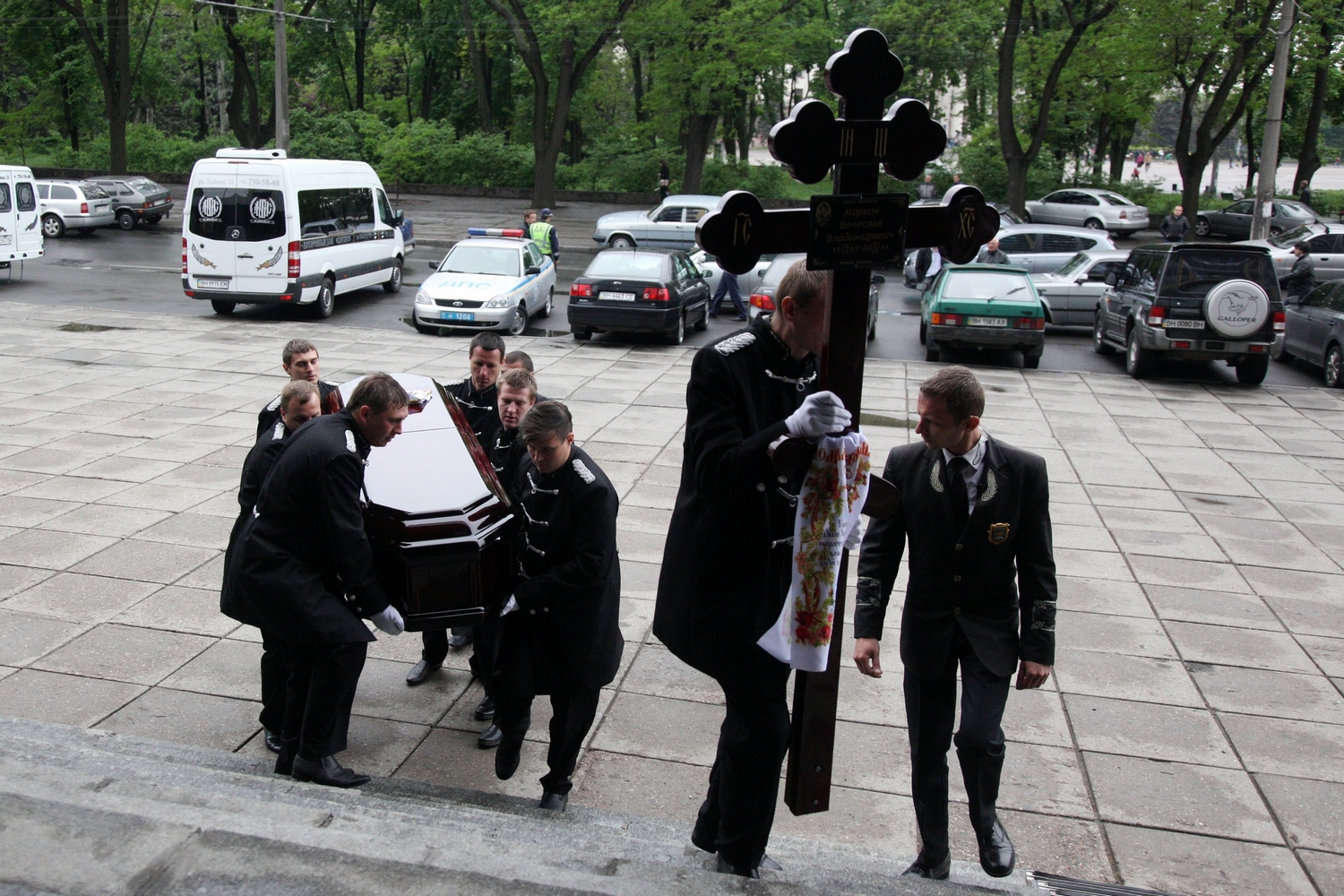
I had never encountered this man before, but from the way those present react, it is clear: Markin was loved. The line slowly moves past the coffin. Women sob, and men do not hold back their tears either. His friends linger beside the coffin for a long time. Grief and genuine sorrow fill the space.
The time allotted for the farewell is coming to an end. People gradually move outside. A man tugs at my sleeve. He holds a stack of A4 sheets with printed text, trying to hand them out right there. I read the headline: “Appeal of Odesa Citizens to the Deputies of the Oblast Council.”
The text speaks of peaceful residents of Odesa who were burned alive by participants in the march for the unity of Ukraine. It goes on to ask the deputies to appeal to international organizations to create a commission to investigate this crime against humanity. At the end — a demand to send international observers and a peacekeeping contingent to Odesa. And most importantly — to suspend any elections in Ukraine until the investigation is completed.
A grand funeral procession moves outside. The coffin, accompanied by the cries of relatives and friends, is carried into a bus.


There are screams, sobs, chants of slogans all around... This marks the beginning of the work of a group of “mourners” standing nearby. I did not see these women near the coffin on the second floor. A rally is raging right here, with its organizers and leaders.
A man with medals and a St. George ribbon on his chest carefully squeezes out tears. All the journalists shift their attention here — and the group works diligently for the cameras.


The procession heads to the cemetery. I return to the hotel.
Richelieu Street. Old, powerful plane trees that make the city center feel so cozy. Somewhere near the corner with Jewish Street, a very young boy in worn-out clothes, who has been following me for a block, finally dares to approach.
“Are you a journalist?”
When I nod, he squints slyly and blurts out: “We won’t let them come here again!”
P.S. The news reported fighting near Sloviansk. There were losses.
I walked around this place dozens of times before that May day, and dozens after. This is where the heart of the city beats.
At the corner of Preobrazhenska Street and Deribasivska Street, everything is covered in flowers and blue-yellow ribbons. On the fence separating the roadway, a portrait of a young man hangs. It was here on May 2, when supporters of Ukrainian unity began to crowd pro-Russian activists, that a bullet ended the life of Andriy Biryukov.
A brief civil memorial service. Two women, shattered by grief — one young, one older — stand by the coffin. Friends and acquaintances are nearby. Meanwhile, people hurry to work. Passengers in buses and trams passing by seem to watch indifferently.
Andriy’s coffin is taken away.
In recent days, the city has been burying the dead and slowly coming out of shock.


Yesterday, I didn’t shoot.
I didn’t go to Kulikovo Field either. The Trade Unions Building has become a memorial. People go there with flowers and candles.
I didn’t go.
I don’t want to photograph yet another funeral, which is now taking place in Odesa almost every day. I’m tired of touching human grief. I feel an overwhelming exhaustion — as if weights are tied to my legs.
Everyone is waiting for May 9. Rumors are spreading through the city: pro-Russian forces are preparing a “response” to May 2. People talk about saboteurs. On the Internet — about possible actions by Ukrainian radicals.
We’ll see what happens tomorrow.
Today I’m just walking around sunny, half-empty Odesa.


The day everyone had been waiting for has arrived.
The eternal flame burns at the center of the cast-iron wreath, while the overheated air trembles nervously above its yellow tongue. Like guards, policemen stand motionless beside it. The entire Taras Shevchenko Park is filled with groups of law enforcement officers.

People walk along the Alley of Glory toward the Monument to the Unknown Sailor. Dozens of medals quietly clink on the chest of an elderly man in a naval uniform — too many for his age. Young and old alike carry flowers. A small group stands somewhat apart, holding portraits of their relatives in World War II uniforms. A light breeze flutters the St. George ribbons on their chests.
Marching in lockstep, a company of cadets from the military academy proceeds along the Alley of Glory. Some time later, naval cadets march toward the monument. A military orchestra forms up. Everything is ready for the ceremonial parade. An old man near the eternal flame adjusts a stylized red Victory banner.
Everything is as usual. This kind of ceremony happens every year. But today, something feels restrained, too quiet. The looks are overly focused, the faces tense.
At last, the orchestra bursts into sound. The military units pass the monument in a ceremonial march. The official part is over. People begin to disperse. Almost immediately, a large flower- laden column led by Afghan war veterans slowly advances along the Alley of Glory toward the eternal flame. Everything passes without incident.
I still need to get to Kulikove Field.


The Trade Unions Building gapes with black windows. A man on the roof catches my eye — he’s fastening a red flag there, then stands for a long time in quiet contemplation. The square is almost empty. Only a small group with a red flag stands near the entrance. Everything seems fairly calm. They aren’t even bothered by the Ukrainian national flag on the flagpole in front of the facade. Small groups of police are scattered around the perimeter.
I don’t linger. I want to see the roads leading to the city.


At the traffic police post on the Kyiv highway, a pair of APCs stands with their heavy machine guns turned toward the empty road.
I head toward the airport roundabout. There are APCs here as well, a military tent, and paratroopers building fortifications.
I approach a large pile of sand. A soldier standing aside watches me with suspicion and adjusts his rifle. He’s on guard. His comrades are filling sandbags. I show him my passport and take a few shots. We exchange goodbyes.
I can’t help saying — the words seem to break out on their own: “Guys, if you see people with weapons and St. George ribbons — take them out without warning.”
I catch their surprised looks.
Cars rush past us around the circle toward the city. Large billboards with political advertisements catch my attention. Friendly, respectable candidates smile down from them.
There are a little over two weeks left until the presidential election.


Another gloomy morning in Odesa. After yesterday, it’s clear there will be no more unrest. I feel the urge to go home, but decide to stay until the evening. Today marks the ninth day since people died in the Trade Unions Building, and a memorial meal is planned there.

Kulikove Field is crowded. A long improvised table, put together from pallets and chipboard, stands in the center of the square, gradually filling with food. People keep bringing food and placing it on the table.
Closer to the entrance, the atmosphere is completely different. Portraits of the dead stand here, relatives are crying, people bring flowers and candles — an atmosphere of searing grief hangs in the air. It’s hard to watch a mother weeping beside the portrait of her son in military uniform. The father of Ihor Lukas, the youngest of those killed, stands for a long time in the center of a circle of people, holding his son’s portrait.
In the lobby, amidst the debris and disorder, an elderly woman walks slowly across the broken plaster. It feels as if her pain is about to burst out from behind the hands covering her mouth. Some people climb further up the stairs, others remain frozen in doorways, overcome with sorrow.
Between the blackened walls of the second floor — people, candles, icons, tears.
Voices from outside grow louder. A rally is already underway, and anyone can speak in front of the crowd. Participants read poems, deliver speeches.


I go down to them. After a while, everyone gathers around the table laid with food. The noise fades. The sounds of prayer drift softly over Kulikove Field. A young priest serves a memorial service in the center of the square. Around him — people with solemn, grieving faces. Some embrace, some cry. A Soviet flag lazily flutters in the wind.


The prayer subsides. The priest speaks for a few more minutes and then leaves the square. The memorial meal becomes livelier, people crowd around the table and start eating. I take some photos and leave too.

I am filled with deeply conflicting emotions standing in front of the Trade Unions Building. After the experience in Donbas, my tolerance for anti-state manifestations is zero. But as time passed, my understanding of the tragedy in Odesa grew sharper, and with it came compassion for the people who had been so ruthlessly used as a kind of sacrifice.
In August 2014, when the war in Donbas was already raging in full force, I met an acquaintance — a Russian photographer — at the well-known “Khrest” checkpoint in Debaltseve. Back then, Russian journalists could still work on both sides of the front line. His words struck me. Many of the Russian “volunteers” he encountered said it was the May events in Odesa that had pushed them to go to war in Ukraine.
In the evening, I caught the train to Kyiv. The next day was Sunday.
P.S. On May 11, “referendums” were held in Donetsk and Luhansk. The “people’s republics” declared their “independence.”
On June 4, after three days of fighting, the Luhansk border guard unit abandoned its base.
The border was left unprotected.
Columns of Russian military equipment began entering Ukraine.